
Spencer has retired.
Microsoft has officially confirmed that Phil Spencer, CEO of Microsoft Games, will be leaving the company after 38 years with the company. Xbox President Sarah Bond will also be leaving at the same time.Sarah BondThis was a major upheaval for the management of Xbox and Microsoft's gaming business.
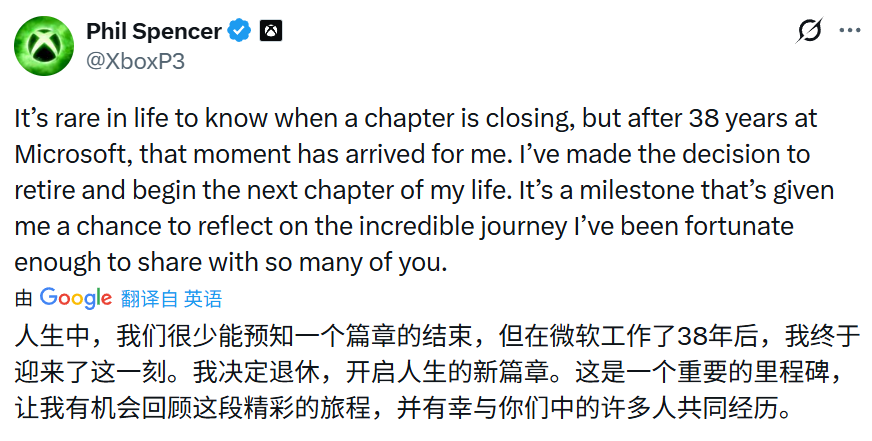

Spencer himself also posted a farewell tweet, "Thank you to everyone who participated in this chapter."
For gamers worldwide, Spencer's tenure as "Xbox CEO" almost completely overlapped with two generations of Xbox, making him one of the most prominent figures in Xbox history.
Spencer joined Microsoft as an intern in 1988, where he worked on projects such as personal finance and office software. He joined the Xbox team in 2001. In 2014, when Microsoft's gaming business was at a low point, he was appointed head of Xbox.
That year, Xbox also officially passedBesTVEntering the Chinese mainland market. Newly appointed Spencer also released a letter of thanks, stating, "This milestone is significant for our partnership with China and our global expansion plans… We will continue to work closely with our partner BesTV to bring exciting games, entertainment content, and app experiences to players across China, allowing them to fully enjoy them."

Also in that year, due to various strategic shifts before and after the launch of Xbox One, the pressure from public opinion was still brewing: the bundling of motion-sensing devices, the focus of publicity on family entertainment positioning, and a series of ideas about digital rights management before launch (such as stricter online connectivity and restrictions on second-hand transactions) all triggered a strong backlash from Xbox players.
Over the next decade, Spencer embarked on a long journey to reshape the Xbox brand image and credibility: promoting backward compatibility within the Xbox ecosystem; vigorously advancing Xbox Game Pass and reshaping Xbox's value proposition with a subscription model; and pushing Microsoft Games to actively acquire numerous studios and continuously expand its content offerings. During this period, Xbox transformed from a console of the old generation into a cross-device service and ecosystem.
Today, the official TGA account also posted a tweet with the caption "Remembering the old days," accompanied by a photo of Spencer with former Nintendo of America president Reggie Fils-Aimé and former Sony Worldwide Studios president Sean Ryden.

This photo was taken at the 2018 The Game Awards ceremony. At that time, executives from Sony, Microsoft, and Nintendo jointly delivered the opening remarks, a moment widely seen as a symbol of unity and collaboration within the gaming industry. And now, the three...The representatives of the "Big Three" all coincidentally chose to retire at the age of 58.

All that is gone.
Returning our focus to Microsoft Games, another surprising aspect is the simultaneous departure of Sarah Bond. During the Activision Blizzard acquisition process, Sarah Bond was responsible for business development and partner-related work within Xbox. She also testified in court during the acquisition proceedings and hearings, serving as one of the key witnesses in Microsoft's communications with regulatory agencies.
After being promoted to a higher level,She is responsible for platform strategy and external cooperation, and has also participated in key businesses such as hardware, subscriptions, and cloud gaming.For the past few years, the Xbox president has been regarded by the outside world as Spencer's successor.

Last summer, Spencer and Bond also came to Shanghai together to attend ChinaJoy 2025 and experienced games from several partner companies.
However, with Bond's departure, Asha Sharma, currently the president of Microsoft Core AI products, will take over as CEO of Microsoft Games.

To outsiders, this candidate was completely unexpected, giving the impression of a "sudden turn of events".SharmaHer resume also lacks experience in the gaming industry: she has served as the chief operating officer of a fresh food e-commerce platform and has also held senior management positions related to product development at a social platform company. After returning to Microsoft in 2024, she was responsible for the Core AI product direction, which is part of Microsoft's AI platform and toolchain.
However, Microsoft CEOSatya NadellaThe internal memo described the transition as a "planned succession": Spencer will continue to assist with the transition as an advisor until this summer, and the head of Xbox Studios...Matt ButtieHe was then promoted to Executive Vice President and Chief Content Officer, partnering with Sharma to oversee the content and studio system.
However, for the player community, which has always been particularly sensitive to the idea of "parachuting in a professional manager to run a game company," the most direct concern remains: Sharma has almost no clear and public player identity, and lacks experience in game content production and front-line projects; coupled with her past experience mainly focused on AI and platformization, this background seems to be a sure-fire way to make mistakes when applied to the game business.
Perhaps taking these concerns into account, Asha Sharma published an extremely long internal letter, the full text of which is as follows:
The humility stems from the extraordinary achievements this team has built over decades; the urgency lies in the fact that the gaming industry is undergoing a period of rapid change, and we need to act with clarity and determination. I will be taking over a role shaped by generations of artists, engineers, designers, writers, musicians, operators, and others who have created worlds that bring joy and profound personal meaning to hundreds of millions of players.
The craftsmanship here is exceptional, and this is amplified by Xbox – from its inception, Xbox firmly believed that the power of gaming could connect people and drive the industry forward.
Thank you to Phil for his leadership, and thank you to every studio, platform, and operations team for laying the foundation. We are guardians of some of the most beloved stories and characters in entertainment, connecting players and creators in entirely new ways around the fun and community surrounding games. My first job was simple: to understand what made this a business and to protect it. It started with three commitments.
First and foremost, great games. It all starts here. Before doing anything else, we must have great games that players love. Memorable characters, emotionally resonant stories, innovative gameplay, and creative brilliance. We will empower our studios, invest in iconic franchises, and support bold new ideas. We will take risks. We will enter new genres and markets, as long as we can provide real value in what players care about most.
I promoted Matt Buttie precisely to fulfill this promise. He understands the craft and challenges of creating great games, has led teams to deliver award-winning titles, and has earned the trust of game developers across the industry.
Second, the return of Xbox. We will reinvest in our commitment to our core Xbox fans and players—those who have been with us for the past 25 years—and to the developers who have built the vast universe and experiences embraced by players worldwide. We will celebrate our roots with a renewed commitment—a commitment to Xbox that begins with the console itself, which shaped who we are. It connects us with the players and fans who have invested in Xbox, and with the developers who have created ambitious experiences for it. Today, games exist across multiple devices, no longer confined to the boundaries of any single hardware. As we expand to PC, mobile, and the cloud, Xbox should be seamless, instant, and worthy of the communities we serve. We will break down barriers, enabling developers to “build once” and reach players everywhere without compromise.
Third, the future of gaming. We are witnessing the reinvention of "play." To seize this moment, we will create new business models and new ways to play by deeply exploring our existing assets: the iconic teams, characters, and worlds that people love. But we will not treat these worlds as static IPs to be exploited and monetized. We will build a shared platform and tools that empower developers and players to create and share their own stories. As monetization methods and AI continue to evolve and influence this future, we will not chase short-term efficiency, nor will we flood our ecosystem with soulless AI garbage content. Games are, and always will be, art: created by humans and realized on the most innovative technologies we offer.
The next 25 years belong to teams that dare to create surprises, dare to try what others won't, and have the patience to see it through to the end. We've done it before, and I'm here to help us do it again. I want to return to the "rebellious spirit" that was once the foundation of Xbox. This will require us to relentlessly question everything, revisit processes, protect what works, and bravely change what doesn't.
Thank you for welcoming me to this journey.
The core message of this internal letter can be summarized in three points: First, putting "great games" back at the starting point; second, emphasizing the "return of Xbox," especially recommitting to core users starting from the console; and third, discussing the "future of gaming," proposing that in the context of commercialization and the accelerated evolution of AI, we should not pursue short-term efficiency or let low-quality content overwhelm the ecosystem, and emphasize that games should still be an art form created by humans.
Well, Microsoft isn't stupid; every sentence in this letter is precisely designed to avoid potential pitfalls.

In his farewell letter, Spencer wrote that Xbox is not just a business, but a community made up of players, creators and teams.
In a sense, this statement presents the most challenging question for the successor: after acquiring Activision Blizzard, Microsoft Games has entered a larger and more complex new phase of platformization. However, beyond scale and efficiency, the most difficult aspect of brand building in the gaming industry remains how to continuously create great games that are recognized and loved by players.
Just like Reggie said in his opening remarks at the 2018 TGA:
With Phil Spencer's retirement, the old-generation "console war" narrative has almost completely come to an end.
The smoke of battle has cleared, but that doesn't mean the competition itself has disappeared. Xbox's successors will still have to work with their competitors to answer the question of "moving forward" in the new era.

This article is a user submission and does not represent the views of this website.
The copyright of this content belongs to the original author. Please contact the original author for authorization before reprinting. For any copyright infringement issues, please contact copyright@jaketao.com
