
As the start of the Christmas shopping season, "Black Friday" is also the most watched shopping event globally, with tens of thousands of consumers in Europe and America voting with their wallets, making Black Friday's spending data an important indicator. Recently, data released by market research firm Circana showed that even with the boost from Black Friday, the game console industry still experienced its worst November since 1995.
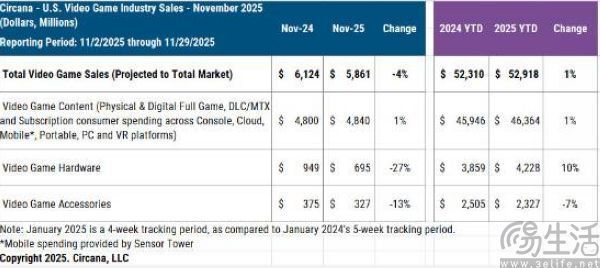
Compared to the same period last year, overall game console sales in the US have declined by 27% this year, with only 1.6 million units sold per month. Microsoft's Xbox Series X/S performed the worst, with sales plummeting by 70% compared to November last year. Sony's PlayStation 5 fared slightly better, with sales declining by 40%, while Nintendo was less affected, with Switch sales falling by only 10%.
Not only in the US market, but also in the UK, Europe's largest gaming market, total console sales have fallen by 17%, according to data released by another market research firm, NielsenIQ.
So the question is, why did game consoles have their worst market performance in 30 years during this year's traditional Christmas shopping season in Europe and America?
In response to this question, Microsoft explained in a blog post that Xbox console sales are currently facing a problem: players are almost entirely buying games online, causing them to stop visiting traditional game retailers like GameStop. However, expanding the console gaming market requires impulse purchases in physical stores, and the wave of GameStop closures makes it difficult for the console gaming community to attract new customers, ultimately resulting in a decline in hardware sales.
While Microsoft's explanation can explain the poor sales of game consoles to some extent, it is too one-sided, because the digital gaming boom did not originate in the past few years, but is a phenomenon that has lasted for more than a decade.
Some might say that the high price deters players, given that the Xbox Series X/S and PS5 are currently priced even higher in the US market than they were when they were released five years ago.
The problem is that, as a representative of the "lipstick economy," people still have a strong desire to consume when the economic environment cools down, and they turn to buying lower-cost games and entertainment. For example, when the 2008 financial crisis swept the world and the US economy immediately entered a recession, the gaming industry seemed to be unaffected. GameStop announced the following year that its sales revenue for the previous Christmas shopping season had reached a record high, with a year-on-year increase of 22.3%.
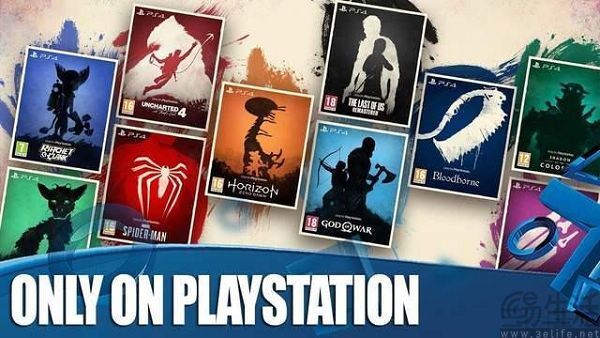
Regarding the real reason why players are losing interest in game consoles, former Sony PlayStation executive Shawn Layden revealed the secret during a podcast appearance: "Exclusive games are key to the brand value of a game console." He cited Mario from Nintendo's Super Mario Bros. series and Nathan Drake, the protagonist of Uncharted on the PlayStation platform, as examples, pointing out that players often decide which game console to buy based on their favorite IPs.
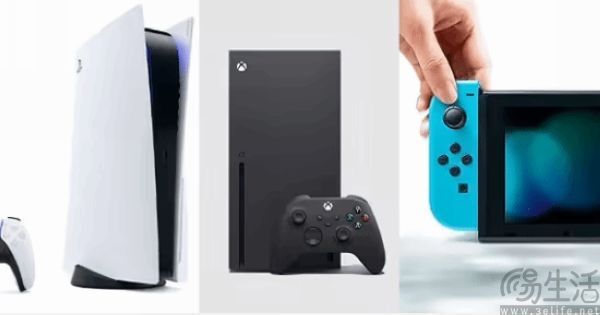
Indeed, this is the reality. Xbox, which completely abandoned exclusivity, performed the worst, followed by Sony, which actively promoted exclusive titles on PC, while Nintendo, which insisted on exclusivity, was the least affected. Since the PS4 and Xbox One adopted the same x86 architecture as PCs in 2012, the line between game consoles and PCs has become increasingly blurred. In fact, after losing the advantages of custom architectures, consoles can no longer outperform contemporary PCs in terms of hardware performance.
Without the performance advantage, the biggest difference between game consoles and PCs lies in the game lineup. Before Sony released its first-party games on PC, players who wanted to experience games like God of War, Uncharted, and The Last of Us had to buy a PlayStation. The ultimate form of exclusivity is Nintendo's adherence to the "first-party wins" principle. Despite the Switch's weak hardware, they still achieved outstanding market performance, relying on the fact that players could only play games from IPs like Mario and Zelda on the Switch.
Without exclusivity, PlayStation, Xbox, and PC are virtually indistinguishable for gamers. To be precise, PCs can do more, given their productivity capabilities; their advantage lies in seamlessly integrating entertainment and work. Even disregarding productivity, PCs have a greater advantage in pure entertainment, for example, the vast array of mods is PC-exclusive.

In terms of performance and expandability, game consoles are clearly no match for PCs. Only by returning to exclusivity can consoles gain an advantage, where a game can only be experienced on a specific platform, and players have to purchase the corresponding hardware to play it. Therefore, while a multi-platform strategy is good for players, it may not be so good for console manufacturers.
This article is a user submission and does not represent the views of this website.
The copyright of this content belongs to the original author. Please contact the original author for authorization before reprinting. For any copyright infringement issues, please contact copyright@jaketao.com

