
Reviewing AI-generated garbage code has become the latest "daily nightmare" for maintainers of open-source game engines.
"I don't know how much longer we can hold on."
A recent comment by Rémi Verschelde, the lead maintainer of the Godot engine, has caused a stir in the open-source game development community. This tech guru, who should be basking in the joy of code optimization, is now facing a deluge of "..." comments on GitHub every day.AI garbageThe pull request (PR) let out a weary sigh.
The dilemma of open sourceThe proliferation of "AI-generated garbage" is causing great annoyance to reviewers.
As an open-source game engine that has gained immense popularity in recent years, Godot has always been known for its "friendly, open, and welcoming" approach. Any developer is free to submit code to the project, and this pure community collaboration model was once its main appeal.
But the AI wave came too fast, like a sudden downpour without warning. Today, Godot's GitHub repository is being flooded with more and more AI-generated, uncomprehended, and even meaningless code modification suggestions.
“These modifications are often completely meaningless,” veteran game designer Adriaan de Jongh pointed out incisively. “What’s even more outrageous is that even the people who submit the code can’t understand what the AI has written.”
For maintainers like Verschelde, the nightmare began. They had to spend countless hours each day reviewing every new contributor's PR like "opening a blind box," constantly wondering: "Is this genuine insight, or just some random 'expert' from AI?"e-waste'?'
"This is a huge waste of time," de Jongh admitted. The review process was originally intended to ensure code quality and encourage excellent contributions, but it has now become a mechanical process of filtering out junk.
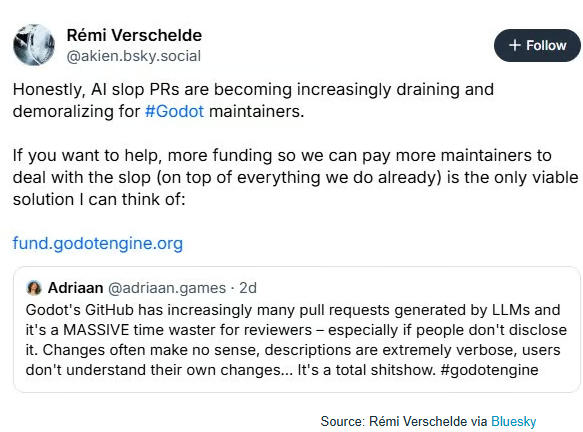
Verschelde described it more specifically: "We had to guess repeatedly, doing this multiple times a day." For a project that relies on the enthusiasm of the community, frequently rejecting contributions from newcomers goes against the spirit of open source and also makes the reviewers feel frustrated and "depressed."
The root of the problem lies in the misalignment of motivation. Some submitters seem to regard "submitting PRs to well-known open-source projects" as an achievement that can be easily achieved, or as a testing ground for AI tools, without considering whether the code is truly valuable or conforms to standards.
As commentator IIIVagrant noted, “Humans create tools to help us do things faster, assuming we would use the extra time saved to improve the quality of things. And the top 20% of users do exactly that. But the remaining 80% always use that extra time to make things more frequently, and the quality completely spirals out of control. This further inflates the premium for quality work, making it a luxury, while the general public is forced to confront the fact that, over time, the quality of things that are generally accessible and affordable is getting worse and worse.”
User Klutzy Kale commented, "It's like giving a monkey an EUV (Extreme Ultraviolet) lithography machine; it still won't become a semiconductor expert." While the analogy from this developer in the community is sharp, it vividly illustrates the point.tool abuseThe contradiction between this and the lack of professional knowledge.
Community reaction: The problem isn't AI, it's the garbage producers.
Godot's predicament is not an isolated case. Whether you like it or not, the penetration of AI into game development is an irreversible industry trend. Even commercial engine giant Unity is heavily promoting AI tools and is about to announce new technologies.
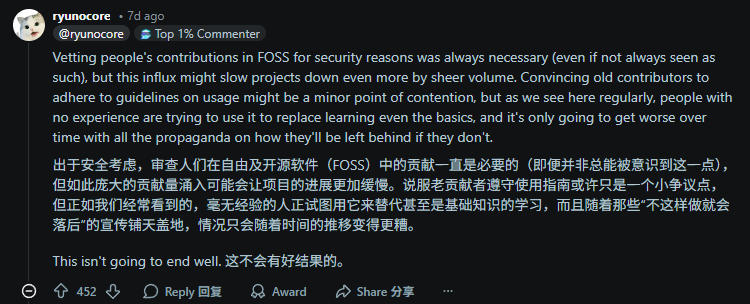
It's undeniable that AI can improve efficiency and assist in creative work. However, a more pressing issue now is: what happens when low-quality, meaningless AI-generated content floods open-source projects?Collaboration thresholdWhat should we do during the review and approval process?
The community reaction has been mixed. One side believes this is an inevitable growing pain of technology adoption, and the problem lies in the "garbage" rather than "AI" itself; the other side worries that if left unchecked, the creativity and vitality of open-source projects will be stifled by this "noise".
Strengthening the review mechanism is the most direct demand at present. However, this means a heavier manpower burden for open source project maintenance teams that already rely on volunteer contributions.
In the long run, this may require community consensus, a reshaping of submission guidelines, and even tool-level assistance in screening submissions. How can we embrace the benefits of technology while safeguarding open-source collaboration?Soil qualityThis has become a question that all project maintainers must consider.
The weary cries of Godot maintainers serve as a wake-up call. They ring for all newcomers eager to use AI in the open-source community, and for everyone who benefits from open source but may inadvertently damage its ecosystem.
When the ideal of "everyone can participate" meets the reality of "everyone can create garbage," is it time to upgrade the rules of the open source world?
This article is a user submission and does not represent the views of this website.
The copyright of this content belongs to the original author. Please contact the original author for authorization before reprinting. For any copyright infringement issues, please contact copyright@jaketao.com

