
Southeast Asia, a market once considered a "red ocean of low prices" by e-commerce practitioners, is undergoing a profound transformation.
Due to geographical distance and cultural similarities, Southeast Asia was one of the first markets that many e-commerce practitioners noticed. However, for a long time, many people's impression of e-commerce in Southeast Asia has remained stuck in the old tricks of price wars and large-scale product dumping, believing that consumers here mostly focus on cost-effectiveness and that market competition only revolves around "low prices".
However, with improved logistics infrastructure, mature payment habits, and the rise of a younger generation of consumers, the e-commerce ecosystem in Southeast Asia is undergoing a disruptive transformation. This market, once considered to have "lower purchasing power," is gradually revealing its enormous consumption potential and limitless possibilities—especially due to the rise of content-driven e-commerce, which is bringing forth many unprecedented opportunities.
The changes in the Southeast Asian market are not only reflected in the upgrading of consumer demands, but also in the innovation of shopping methods. From traditional shelf-based e-commerce to today's booming content-driven e-commerce, consumers are no longer satisfied with simple product displays; they expect a more personalized and entertaining shopping experience through social and interactive content. Short videos, live-streaming e-commerce, and even social interactions between brands and users are reshaping the rules of brand marketing and e-commerce operations.
At the heart of this revolution is TikTok Shop. It has not only redefined the relationship between e-commerce and content, but also driven an upgrade in interaction between brands and consumers through its innovative "brand, performance, and sales integration" model. This trend was confirmed by both data and practice at the 2025 TikTok Shop Southeast Asia Cross-Border E-commerce Annual Awards Ceremony, which concluded on January 16th.
At the gala, Adam, head of TikTok Shop's Southeast Asia cross-border e-commerce, revealed a set of key data: TikTok Shop's Southeast Asia cross-border e-commerce GMV has grown rapidly for many consecutive years, and the scale in 2025 is more than double that of 2024; the average daily GMV increased by 90% year-on-year, and the peak daily transaction volume at the end of the year was nearly twice that at the end of 2024, highlighting both the resilience of daily operations and the explosive power of peak performance.
The major promotional events have repeatedly broken records, with the year-on-year GMV growth rates of the three core promotional events, 66 Grand Promotion, Double 11, and Double 12, reaching 123%, 230%, and 270% respectively. Among them, the GMV of short video e-commerce on Double 12 surged by 257%, which confirms the effective growth logic of content e-commerce platforms that "good content is the best shelf".


Adam emphasized: "The growth in 2025 proves that Southeast Asia is still booming and that our direction is effective."
This means that in the new development cycle, if brands and merchants want to expand their business in Southeast Asia, they can no longer rely solely on price advantages and simple channel expansion. Instead, they need to gradually transform into shapers of global competitiveness through innovative content e-commerce models.
This is not merely a market expansion, but a completely new business game: brands must find new growth points through content and interaction. In this rapidly changing market, the rise of TikTok Shop has not only shown brands new opportunities but also brought a brand-new business ecosystem to Southeast Asian e-commerce. For many brands struggling with growth bottlenecks, the Southeast Asian market offers more than just a simple channel expansion; it represents an opportunity to reshape their global competitiveness.
The evolving Southeast Asian market
After years of infrastructure upgrades, the Southeast Asian market has passed several key development stages. From the widespread adoption of smartphones to the gradual improvement of logistics networks and the full-scale implementation of mobile payments, these changes have not only improved the efficiency of e-commerce distribution but also profoundly altered the entire business model and profit structure. Compared to five years ago, the e-commerce ecosystem in Southeast Asia has gradually shifted from simple product display to a more diversified, content-driven business model.
These conditions have made online shopping more convenient for consumers, greatly enhancing the shopping experience. However, with the continuous rise in traffic costs for traditional e-commerce platforms, merchants are facing increasing marketing pressure. Against this backdrop, content e-commerce has emerged and quickly gained prominence. Through short videos and live streaming, content e-commerce breaks through the limitations of traditional "shelf e-commerce," more closely integrating brand products with consumer interests and needs. This approach not only effectively increases user engagement but also significantly improves conversion and repurchase rates, thereby driving the optimization of profit structures and enhancing business efficiency.
The success of TikTok Shop is a microcosm of this transformation. Unlike traditional e-commerce, TikTok Shop does not rely on massive traffic influxes, but rather achieves precise matching of "products to people" through its accurate content recommendation mechanism. This matching is based not only on users' interests and behavioral data, but also guides consumers' purchasing decisions through short videos and live streams. This innovative approach not only improves conversion rates but also enhances consumers' willingness to repurchase, thus forming a complete closed loop of "content seeding – interest conversion – repeat purchase retention".
More importantly, TikTok Shop breaks through the pain point of traditional content platforms where "it's easy to discover products but difficult to sell them." By seamlessly integrating e-commerce transactions, short video/live streaming content, and local fulfillment services, TikTok Shop solves the problem of merchants having to switch to external platforms. When users see products they are interested in, they can directly place an order during their peak interest period without having to leave the platform to find payment and logistics solutions. This innovation greatly simplifies the consumer's purchase path, improves conversion rates, and thus drives the platform's commercial benefits.
The success of this model is no accident. The demand for content and interaction among young consumers in Southeast Asia perfectly aligns with the high activity level of the TikTok platform. Data shows that TikTok boasts extremely high user engagement in Southeast Asia, with users spending an average of over 35 hours per month on the platform, far exceeding the global average. Furthermore, influencers wield significant influence over Southeast Asian consumers. According to Partipost's "2024 Influencer Marketing Report," 75% of Southeast Asian consumers have purchased products based on influencer recommendations, and 80% of respondents have made at least one purchase decision based on an influencer's endorsement. TikTok Shop's influencer-driven sales campaigns have become a new bridge between brands and consumers. By collaborating with local KOLs, merchants can precisely reach the most potential purchasing groups, increasing brand exposure and sales conversion rates.
This series of data demonstrates the strong demand for content-based e-commerce in the Southeast Asian market, and TikTok Shop's Southeast Asian cross-border e-commerce platform is precisely positioned at the forefront of this demand. The data from major promotional events proves this point—the GMV of TikTok Shop's Southeast Asian cross-border e-commerce platform during the 2025 12.12 annual promotion surged 2.7 times compared to 2024, with short video sales GMV increasing by 257%.
Consumption upgrading becomes the main theme: structural opportunities emerge
Behind the market growth is a fundamental upgrade in consumer demand. In 2025, the GMV growth rate of all core categories of TikTok Shop's Southeast Asian cross-border e-commerce exceeded 120%, with quality-oriented categories becoming the growth engine: the growth rate of computer and office equipment was nearly 5 times, the growth rate of beauty appliances, maternal and infant products, and health products was more than 3 times, and the growth rate of specialty categories such as home textiles, pet supplies, and Muslim fashion also exceeded 3 times.
It is worth noting that the high-growth categories all focus on quality, experience, and brand image, rather than low prices and high volume. This indicates that Southeast Asian consumers have shifted from basic product needs to the pursuit of a high-quality lifestyle, and are willing to pay a premium for refined experiences, healthy lifestyles, and brands they recognize. The consensus in the market is that "focusing on good products and good brands can sell at high prices," which confirms the huge potential and strong purchasing power of the Southeast Asian market.
As consumer demand continues to upgrade, from standardized to non-standardized products, and from individual consumption to branded consumption, the Southeast Asian market still has a large unmet demand gap, presenting significant structural opportunities. For example, in 2024, the overall e-commerce market for standardized products (including 3C digital products and home appliances) in major Southeast Asian countries reached US.3 billion, with a penetration rate of 24%. The e-commerce market for non-standardized products (apparel and footwear, beauty and personal care, home care, etc.) reached US.8 billion, with a penetration rate of 19%. In contrast, China's e-commerce penetration rates for standardized and non-standardized products were 54% and 33% respectively, a difference of 30 and 14 percentage points, especially for categories like beauty and personal care and home appliances, where there is still considerable room for improvement in e-commerce penetration rates.
The gap between overall category growth data and penetration rate further highlights the benefits of consumption upgrading and the huge market potential in Southeast Asia. With the continued expansion of platforms like TikTok Shop Southeast Asia cross-border e-commerce and the gradual improvement of e-commerce services, Southeast Asia will undoubtedly become a new growth pole in the global e-commerce market. In this transformation, TikTok Shop Southeast Asia cross-border e-commerce not only provides brands with a brand-new sales channel, but it is also reshaping the competitive landscape of the entire e-commerce industry, becoming a core force driving the rapid development of the Southeast Asian market.
TikTok Shop Southeast Asia Cross-Border E-commerce: A Testing Ground for Brand Globalization
Based on these developments, the Southeast Asian market has transformed from a traditional e-commerce market into a new battleground for global e-commerce competition. In this transformation, Southeast Asia is not only a simple place to sell goods, but also a crucial base for brands to achieve rapid growth.
As domestic market growth stabilizes, going global has become a core choice for more and more domestic brands and merchants. Southeast Asia, as one of the world's fastest-growing e-commerce markets, has become the preferred testing ground for Chinese brands due to its similarities in culture and consumption habits. Compared to other overseas markets, Southeast Asia, with its unique advantages of low cost and high returns, has become a platform for Chinese companies to validate their globalization path from "single product to brand, and then to a lasting brand".
Cultural similarities allow Chinese brands to find strong resonance in the Southeast Asian market and quickly gain consumer recognition. More importantly, the diversity of the Southeast Asian market and its increasingly mature e-commerce ecosystem provide a unique "branding window" for Chinese brands. Many brands are no longer solely reliant on price competition, but have entered a new brand tier by improving product quality, strengthening brand stories, and innovating marketing methods. In fact, some Southeast Asian consumers not only seek price advantages but also crave high-quality and high-value-added products, providing enormous potential for the branding and long-term development of Chinese brands in this market.
Many Chinese brands have already achieved remarkable success in Southeast Asia. Instead of getting bogged down in price wars, they have successfully entered a new brand tier by innovating content marketing, strengthening brand stories, and creating differentiated products.
Pop Mart, a trendy toy brand, is widely popular in Southeast Asia, with its IPs like Labubu being particularly beloved by local young people. Perfect Diary, a rapidly rising Chinese beauty brand, has successfully attracted a large young user base in Southeast Asia by collaborating with local beauty bloggers through TikTok Shop, a cross-border e-commerce platform, to launch makeup products tailored to local aesthetics and skin types. Outdoor sports brand Camel has successfully created outdoor apparel and footwear that meet the comfort and climate adaptability needs of Southeast Asian consumers through localized product adaptation. It leverages social media platforms like TikTok Shop, combining short videos and live-streaming e-commerce to strengthen its brand influence and drive sales growth through content-driven e-commerce.
In addition, many beauty brands facing fierce competition in China have achieved a breakthrough in "brand building and sales performance integration" through TikTok Shop's Southeast Asian cross-border e-commerce platform. They capitalized on Southeast Asian consumers' high acceptance of new things, using a combination of short video seeding and live-streaming sales to quickly turn individual products into bestsellers, while simultaneously accumulating a large number of brand fans and building a long-lasting brand influence—this dual value of "selling goods + building a brand" is unmatched by traditional channels.
JMCY is such a domestic beauty brand. It once held a leading position in the domestic market thanks to its high-quality, cost-effective products. However, since launching its overseas strategy in 2024, the brand has rapidly expanded its market in Southeast Asia through TikTok Shop cross-border e-commerce. Leveraging localized marketing and product optimization strategies, it successfully launched its blockbuster products, such as its "three-in-one" double-ended lip gloss, in the local market, disrupting the traditional e-commerce competitive landscape. Today, JMCY's monthly GMV has soared from 0 to 10 million RMB, making it a rising star in the Southeast Asian e-commerce market.
ROCKSWEET is a beauty brand founded by Guangzhou Kaiqi Cosmetics Co., Ltd., aiming to move beyond low-price competition and focus on building a high-quality brand with a story and personality. Launched in 2023, the brand rapidly expanded its market in Southeast Asia through TikTok Shop cross-border e-commerce, achieving significant success, particularly in Vietnam. Its eyebrow tint product topped the Vietnamese beauty charts, selling over 10,000 units within six months. Through collaborations with local influencers, the brand successfully increased brand awareness and built consumer trust, resulting in a 300% increase in sales in the first quarter of 2025 compared to the previous quarter.
The rise of TikTok Shop, a cross-border e-commerce platform in Southeast Asia, has significantly boosted the growth of these brands. For Chinese brands, the business environment of the Southeast Asian market and the innovative marketing tools offered by TikTok Shop have become the best starting point for entering the global market. In a low-cost, high-efficiency environment, brands can quickly validate their globalization strategies, accumulate valuable international market experience, and lay a solid foundation for future expansion into other regional markets.
2026 Strategy: Dual-Engine Drive to Achieve New Speed of Overseas Growth
Behind the impressive growth of TikTok Shop's Southeast Asian cross-border e-commerce over the past few years lies the solid support of its end-to-end ecosystem empowerment. In 2025, TikTok Shop's Southeast Asian cross-border e-commerce provided merchants with a clear business path and specific support through measures such as deepening the influencer ecosystem, creating a year-round collaborative marketing matrix, providing tiered empowerment for merchants at different stages, upgrading the cross-border fulfillment system (launching border warehouses and introducing next-day delivery), and increasing investment in end-to-end resources, turning growth from "accidental" to "inevitable".
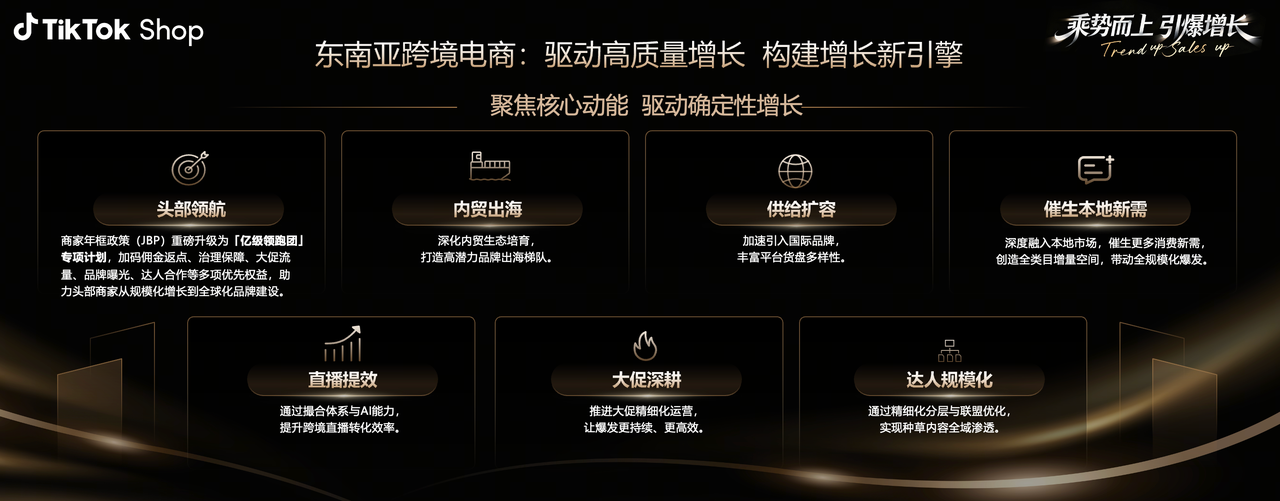
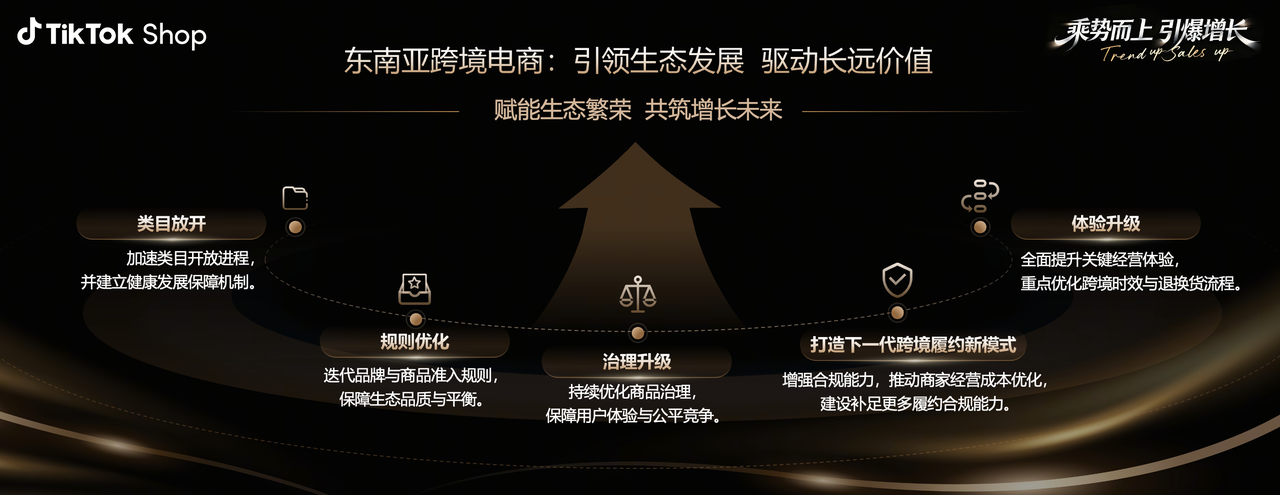
Looking towards 2026, TikTok Shop's Southeast Asian cross-border e-commerce strategy has clearly defined two core directions: "driving high-quality growth" and "building a sustainable ecosystem," forming a dual-engine pattern to help merchants embark on a new era of overseas expansion.
In terms of high-quality growth, TikTok Shop Southeast Asia cross-border e-commerce will launch the "Billion-Level Leading Group" special program, which will focus on supporting leading merchants to carry out global brand building, while leading more domestic trade brands and merchants to go global, accelerating the introduction of international high-quality brands and further enriching the supply of goods; at the same time, it will upgrade the efficiency of live streaming operations and the refined operation of major promotions, and continue to amplify the integrated growth efficiency of "content + shelf".
In terms of building a sustainable ecosystem, TikTok Shop Southeast Asia cross-border e-commerce will advance the process of opening up product categories, optimize brand access and product governance rules, and ensure a healthy and fair ecosystem; it will also create a new model for cross-border fulfillment, and simultaneously improve cross-border timeliness and return and exchange experience, laying a solid service foundation for merchants' operations.
As Adam emphasized, in 2026, TikTok Shop Southeast Asia cross-border e-commerce will work with all merchants to achieve "a new speed of overseas growth".
Looking ahead, the trend of content-driven e-commerce in Southeast Asia is clear: short-video content will become a core driver of consumer purchasing decisions, and the integration of social e-commerce and content will deepen further, enabling brands to enhance consumer engagement and loyalty through precise content marketing. For decision-makers, the key to fully investing in the Southeast Asian market lies not only in assessing market potential but also in considering whether brands can quickly build and supplement their core capabilities within an affordable budget.
As competition intensifies in the domestic e-commerce market, Southeast Asia remains a "blue ocean" brimming with opportunities. However, with increasing competition, these opportunities won't last forever. Decision-makers must seize this critical period of transformation, rapidly deploying strategies and gaining a first-mover advantage to ensure long-term success in the Southeast Asian market.
This article is a user submission and does not represent the views of this website.
The copyright of this content belongs to the original author. Please contact the original author for authorization before reprinting. For any copyright infringement issues, please contact copyright@jaketao.com
