
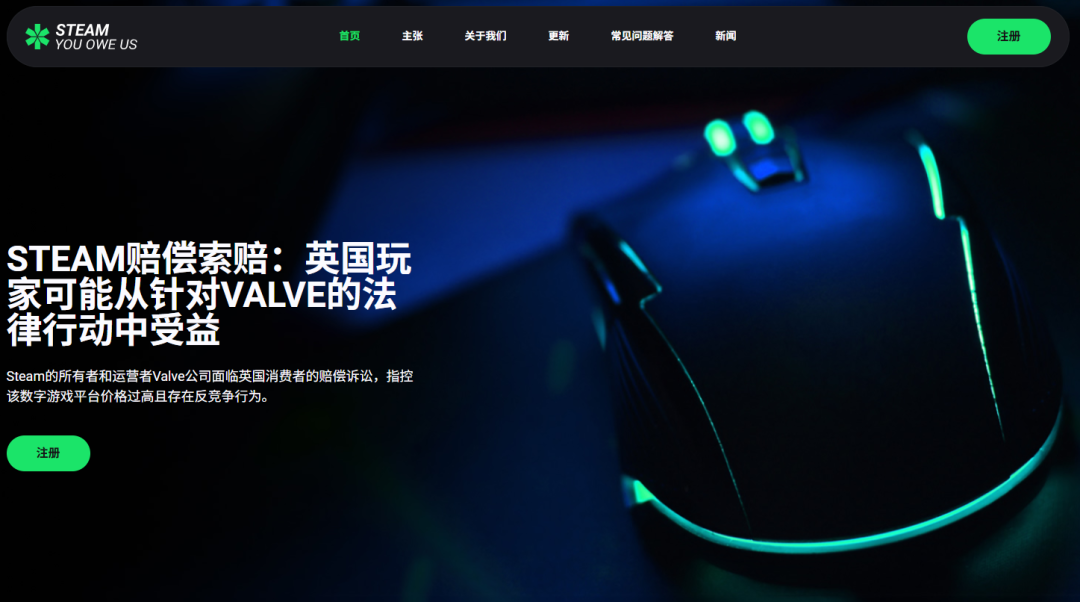

In the United States, Steam has faced similar accusations. Game developers Wolfire and Dark Catt Studios have also filed lawsuits against Steam, alleging that its 30% commission is used to exploit publishers and consumers with its industry dominance. The two cases were later merged into one, and in late 2024, the dispute had been converted into a class action lawsuit, allowing developers, publishers and individuals who paid commissions to Valve after 2017 to join and sue Steam.
与此同时,许多国家都在向Steam平台要求进行一些内容监管、数据安全领域的保障,比如土耳其、俄罗斯等国都要求Steam对于平台上的游戏依照当地的法律规定进行审查,随着各国对互联网主权的日渐重视,类似的监管可能会更加普遍或加码。

In addition, Steam is also facing pressure from transnational payment channels such as PayPal, Visa and MasterCard. After Steam updated its content distribution guidelines last year, which resulted in the large-scale delisting of adult games on the platform, it has become a fact that NGO organizations put pressure on Steam through payment channels to conduct indirect ethical review.
The reason why Steam has ended up where it is today can be summed up in one sentence:The tree attracts the wind.
From a third-party perspective, many of the accusations against Steam actually occur on other distribution platforms in the market. For example, the 30% commission is still common on platforms such as GOG and console Yusanjia. The reason why it can be used to accuse Steam is essentially because Steam’s market dominance on the PC platform is too stable, making it difficult for competing products Epic and GOG to directly challenge Steam.

So after becoming the target of public criticism, how will Steam's future operations change? Will it follow in the footsteps of Google and Apple and give profits to developers and players?

To answer this question, it is necessary for us to systematically introduce the current situation of PC game distribution channels and understand itsHow are the competing products doing?
In order to compete differentiatedly with Steam,Challengers such as Epic and GOG have embedded their own brand narratives into the public opinion field in the gaming circle.Therefore, among the various agenda settings currently being carried out by European and American game media, we can find that some issues can find corresponding beneficiaries under various "coincidences".
For example, requiring the platform to reduce commissions is a sharp sword for Epic to challenge Steam. Whenever Steam is criticized for its 30% commission, you can always see Epic voicing support to Steam protesters, as if it has never evaded its identity as a stakeholder and wants to fight a business war in front of players.

Epic has implemented its "low commission" brand narrative very thoroughly. It has not only formulated extremely favorable platform policies for developers in its own mall:EpThe commission from ic mall is only 12%, and there are games under the manufacturer'sBefore the net income of the entire platform reaches US million, the Epic platform will not charge any channel commission at all.
If the game also uses the Unreal Engine, or participates in preferential policies such as the Epic launch plan, the share ratio can be reduced to 5%-3.5%, and it can even be exempted from commission within 6 months of release.

In addition, Epic also personally left the show to say goodbyeThere was a "war of the century" with Apple and Google over the 30% commission issue.And achieved partial victory: In the European market, Apple and Google were forced to open third-party app stores, alternative payment channels and reduce platform commissions. The US court also made a similar ruling against Google. In addition to the fact that Apple won the support of US judges in 9 out of 10 accusations and maintained its platform dominance through a series of micro-manipulations, these lawsuits by Epic can be said to have a certain degree of success.Breaking the 30% channel share convention in the gaming industry.
After Epic tore a hole in Apple and Google's platform hegemony, the Japanese and South Korean governments also tried to replicate the EU's policies towards Apple and Google, requiring them to connect to alternative payment systems.

Although Epic has been victorious in the field of mobile games through lawsuits and has become a "dragon slayer", it has not broken out and directly gone to court with Steam in the PC field. Because even after Epic has given away games to "buy" players for many years,The appeal of Epic Mall to consumers is still limited.Some developers even believe that Epic is actually helping Steam advertise by giving away games.
Even if we hold high the banner of "low commission", which has its own halo, "Alan Wake 2》 and a series of tests on exclusive strategies have proved that Epic currently does not have the ability to engage in a "choose one" type of exclusive competition with Steam. If Epic takes the risk of having its own products removed from the shelves and sues Valve in the name of antitrust as it did against Google and Apple before, it will be hard for Epic not to get burned once the conflict escalates and affects the core interests of Steam users.

Since Epic is exclusive on the PC platform, "Alan Alan Wake 2" has won many awards, but the road to return is extremely long.
On the contrary, now that the British NGO organization has filed an antitrust lawsuit against Steam, Epic can reap the benefits. Therefore, some players follow the logic of "whoever benefits, whoever is suspicious" believe that this lawsuit is driven by Epic behind it, but this statement is still just a conspiracy theory.

In contrast, GOG has chosen a narrative that is more closely bound to the players:Game saving and de-encryption.
Due to historical reasons in some Eastern European countries, players in the region largely gained their gaming experience from pirated games. Therefore, unlike mainstream European and American game manufacturers, game manufacturers such as CDPR did not put extreme pressure on pirated games. Instead, they retained a relatively high level of tolerance and gave birth to the GOG platform (Good Old Games).

The main idea behind the establishment of GOG is to make old games compatible with current devices through reverse engineering.and distribute these wireless products through online channelsDRMCrypto games. Therefore, its platform policy is very tolerant to players, not onlyAllow players to distribute copies of the game themselves,And it will relax the time for full refunds from two weeks on other platforms to 30 days, regardless of whether the game is downloaded or played.
Later, GOG officially launched the GOG preservation plan, announcing that it would continue to maintain more than a hundred old games on the platform to ensure that they can maintain compatibility with the current system, and cooperate with the European Federation of Game Archives, Museums and Preservation Projects (EFGAMP).Protect games as a cultural heritage,To prevent them from disappearing completely due to removal by game manufacturers.

Obviously, compared to a commercially oriented game distribution platform, GOG is more like a charity organization to a certain extent. Its previous standard 30% share ratio does not have much extra appeal to developers (later it became a flexible share model, but 30% is still a reference standard), andIts aggressive platform policies also greatly limit its monetization capabilities.Therefore, in addition to CDPR's own games, few leading manufacturers will launch their new products on GOG. Many of them choose to log on to this platform are independent games and old games from many years ago.

Of course, there are also some manufacturers willing to support GOG
Therefore, GOG's losses seem to be natural. In 2019, GOG had to cancel the "Fair Price Package" plan because it was on the verge of losing money, and implemented differentiated pricing for different regions like Steam. According to the latest data exposed by the media, in the first half of 2025, GOG's net profit was -0.9%. In December of the same year, GOG was sold by CDPR to a founder for independent operation. It is still unknown whether it will continue to operate according to the existing model in the future.

GOG’s current boss Michał Kiciński
However, with the shift in public opinion in the gaming industry in recent years,GOG inexplicably stands on some kind of moral high ground.
Since Ubisoft removed and closed "The Crew》Since the server triggered a large-scale backlash from players, relevantIs the player purchasing game ownership or access license?The controversy intensified. The "Stop Killing Games" movement has collected more than 1.4 million signatures. It requires legislation to require manufacturers to provide reasonable means for games to continue running after they are removed from the shelves or suspended. This proposal has procedurally advanced to the stage of a public hearing in the EU or a plenary debate in the European Parliament.
Players' attention to "Stop Killing Games" made GOG and its game preservation plan once highly praised in the community and the media, but GOG's attitude towards this movement is quite rational. GOG executives told the media that if the legislation is passed,The cost it brings may hinder manufacturers from developing new games.Because game preservation is a very complex issue, involving various dimensions such as intellectual property rights, technical details, and commercial feasibility, the executive pointedly pointed out: "No one will do this in good faith, because that is not how wages are paid."

Coincidentally, there is a more unique niche distribution channel on the PC platform: itco.io, which is a very vertical independent game distribution platform with a strong geeky attribute.Its owners do not operate it for profit;Therefore, the platform's share is very arbitrary. The default share of itch.io is 10%, but it allows developers to freely choose the proportion of the platform's share from 0-100%. They call this the "open revenue sharing" model.

Because this low-threshold attribute is very friendly to novice developers,itch.io is regarded by many as a springboard to Steam.Therefore, it is also a platform for solo developers to communicate with each other. Developers hold game creation marathons (Game Jam, a time-limited activity to improvise games from scratch with a focus on creativity rather than appearance) with various themes.

Dense Game Jam schedule
This characteristic of strong creative atmosphere but lack of commercial attributes means that the itch.io platform does not conduct too much review and management of platform content. Therefore, the number of games on the platform is huge but the quality is mixed. Some are niche products, and some are garbage made in a few hours. It is difficult to call it a mature game distribution platform.
All in all, although we admire distribution platforms like GOG and itch.io that are willing to make profits to developers or players and assume certain public responsibilities, due to certain conflicts between their respective concepts and traditional business logic,They don't have much room to grow to compete with Steam.

Through the above introduction, we can firmly establish the conclusion that everyone knows well:Steam poses no real threat on PC,Even Epic's current size is not enough to shake its market dominance. But for Steam, which has been saddled with multiple antitrust lawsuits, this one-company structure makes it more difficult to defend itself in court.

As for the future direction of Steam's antitrust litigation, our following discussion is not going to focus on the game between the prosecution and the defense on specific legal provisions, but on logical deductions from some more macro external conditions.
It can be seen from our previous introduction to cases such as Epic suing Google and Apple and the "Stop Killing Games" movement.European countries are much stricter than the United States in antitrust litigation and player rights protection in the game industry.Part of the reason for this is that Europe itself lacks industry giants, and there are quite mature NGOs that organize and mobilize on related issues. They also consider protecting their own small and medium-sized enterprises in punishing and pressuring industry giants such as Google and Apple. Judging from the past cases of antitrust cases in European countries, it is difficult for Steam to escape unscathed.

Statistics summarized by foreign media on antitrust investigations launched by European countries against Internet giants
Before these class-action lawsuits, Steam had a tough stance on such accusations. As early as 2021, Steam was fined 1.6 million euros by the EU for regional pricing and refusal to cooperate with the investigation. However, to this day, regional pricing is still strictly enforced by Steam-but when the amount of compensation in today's antitrust lawsuit has risen to 656 million pounds, Steam is unlikely to continue to be tough.
Judging from the current situation of the industry and the accusations it has received, it is difficult for Steam to prove that it does not have a dominant position in the industry.But whether it uses its dominant position to exploit game developers and suppress other distribution platforms is worthy of debate.
At the end of the day, we all can't escape one question: Why does Steam take a 30% commission?

Judging from the two antitrust lawsuits against Steam in the United Kingdom and the United States, the 30% commission is not the only question that the outside world has questioned about it. It also includes whether it includes exclusivity clauses in the contract to force game manufacturers to ensure the lowest selling price on Steam. However, these issues are difficult to confirm in public information, so I won’t go into details here.
The 30% commission has been regarded as industry practice for a long time in the past. Even though Epic has pushed a 12% low commission strategy in the past few years, judging from the increasing number of games on Steam and the continued expansion of the player base,Most players and developers seem to acquiesce to this status quo.

In the current PC game ecosystem, the Steam platform is not only a game mall, it also has a player community, an exposure platform and some industry supervision functions. It also faces very strict requirements from the outside world and has become a kind ofThe infrastructure for PC game distribution is difficult to bypass.
The first and most obvious thing is the unique user base of the Steam platform in the market. These players are not only large in number, but also very active and willing to pay. Industry reports show that in December 2025, more than 100 million Steam users will create a total platform revenue of approximately US.6 billion.
However, a large and high-quality user base is also the result of Steam's years of operation. Although it is well-known in the community for its frequent special offers and amazing discounts, judging from the effect of Epic's years of delivering games,These players cannot be easily bought by offering cheap or free games.Steam's ability to achieve its current status on the PC platform is inseparable from Steam's "efforts".

Some people in the industry believe that the loyalty of Steam users is built by the Steam platform using trophies, game time and other systems to meet social needs. However, the author believes that this perspective is a bit narrow. These little clever things that can be easily copied cannot be the reason why Steam is unique.
From the perspective of a content platform, Steam has a feature that is difficult to replicate on other platforms: it can alwaysScreen out the dark horses of new games that are good enough from the massive products on the shelves.It satisfies the needs of users to continuously consume new content, and provides business returns that are enough to make its developers rich overnight.
Apart from Steam, no other platform canMake one almost zero percentThe games announced this time have achieved sales and revenue comparable to AAA masterpieces.

Although independent game developers and publishers have been complaining that new games on Steam are severely squeezed by old games or well-known IPs,A few popular models attract the vast majority of traffic and exposure resources.Matthew effectIt’s extremely obvious, but after leaving the cradle of Steam, independent games will have to compete with big, wealthy companies for publicity and distribution resources. Under the logic of buying volume, independent games can only compete for some scraps during the window period when major companies announce their releases.
What needs to be acknowledged is thatSteam's current recommendation mechanism is far from perfect.It cannot guarantee that games in every subcategory can find enough audiences, and many games even cannot earn back the 0 paid to Steam when opening a store. However, Steam's current push mechanism that refuses purchases and screens products based on users' actual purchasing behavior is already the most friendly to low-level developers at the moment. The reason why the independent game category has become an entrepreneurial path is largely because Steam really gives developers a chance to change their lives.

If Steam allows purchases and follows the example of Google and Apple in launching an official advertising push platform, then the independent game track is likely to be just a small circle for self-entertainment (like itch.io).Therefore, Steam may only be an amazing user pool for major companies, but it is almost irreplaceable for independent games.
In the face of a fate-changing opportunity, a 30% commission seems nothing.
This article is submitted by a user and does not represent the position of this site.
The copyright of the content belongs to the original author. Please contact the original author for permission to reprint. If there is any infringement, please contact copyright@jaketao.com
